What Are The OSHA Floor Marking Guidelines For Warehouses?
 What Are The OSHA Floor Marking Guidelines For Warehouses?
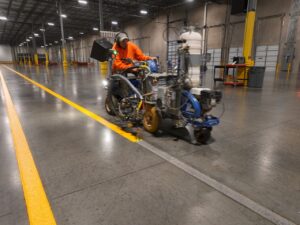
Warehouse striping is a vital service that can transform a chaotic workspace into one that’s safe, productive, and highly organized. These properties are naturally dangerous. You have workers navigating on foot, others operating forklifts and heavy-duty machinery, and loading dock employees moving goods in and out. Striping is a critical piece of the warehouse floor safety puzzle, but what OSHA floor marking guidelines do you need to consider?
How Strict Are OSHA Marking Guidelines?
When most people learn there are warehouse floor marking guides they must take into account, they assume there are strict code requirements governing every little detail. However, that’s not the case. The Occupational Safety and Health Administration (OSHA) has numerous rules for other types of workplaces, but it also recognizes that warehouses have distinct needs. When applying warehouse striping, you must prioritize your business needs while ensuring compliance with all OSHA floor marking requirements.
Fortunately, there’s more flexibility with warehouse striping than most realize.
What Are the Most Critical OSHA Floor Requirements?
OSHA floor marking guide are relatively simple. The biggest rule for Dallas warehouse floor markings is that all permanent aisles and passageways must have “appropriate markings.” You can find these rules in the OSHA floor marking guides covering materials handling and storage.
How Wide Does Striping Need to Be According to OSHA Floor Marking Guidelines?
Beyond those basic OSHA floor marking requirements, your warehouse striping must meet minimum size standards. OSHA advises that Dallas warehouse floor markings that define permanent aisles and passageways must be at least 2 inches thick. The standard is 2 to 6 inches thick for each line.
The warehouse floor markings guide also requires all aisles to be at least 4 feet wide. That 4-foot minimum applies to pedestrian passageways. Those used by forklifts and other equipment must be at least 3 feet wider than the biggest piece of gear to pass through.
Are There Any OSHA Floor Marking Requirements for Color?
OSHA doesn’t have a strict color-coding system in its warehouse floor marking guides. However, there are a couple of exceptions.
First, your markings must use yellow to mark potential hazards. The color signifies caution; use it to mark tripping hazards, danger zones, and more.
The OSHA floor marking guides also mandate the use of red to mark fire hazards and related fire-safety equipment. That includes fire hydrants, emergency switches, fire protection gear, and more.
Beyond those colors, you’re free to develop a color-coding system for your Dallas warehouse floor markings. While OSHA doesn’t have standards beyond yellow and red, many established color codes are widely used in industrial settings.
What’s the Best Way to Improve Warehouse Floor Safety with Striping?
Let Advanced Texas Striping help you maximize warehouse floor safety at your property. We’re an experienced, veteran-founded business that’s built a reputation for quality, reliability, and unmatched customer care. Our goal is to develop solutions that have a meaningful impact on your property and business. You can turn to us for warehouse striping, parking lot striping, restriping, layout design, ADA compliance markings, MMA traffic markings, thermoplastic road markings, and more.
Give the Advanced Texas Striping team a call today at (817) 699-5975 to learn more about what we do and request a free project quote. If you prefer, you can also email us at mark@atstriping.net or use our online form to get in touch.
